


Why authenticity matters in luxury goods: timeless value
TL;DR:
- Counterfeiting causes significant economic harm, job loss, and supports organized crime across Europe.
- Authentic Italian handbags are handcrafted with high-quality materials, ensuring durability and investment value.
- Choosing genuine luxury items reflects a commitment to craftsmanship, heritage, and personal values.
EU authorities seized over 112 million counterfeit items valued at €3.8 billion in a single year, with handbags and accessories among the most seized categories. That figure alone should give any discerning buyer pause. Yet the conversation about authenticity in luxury goods rarely goes far enough. It stops at “real versus fake” and misses the deeper story: what authenticity actually guarantees in terms of craftsmanship, investment security, and personal legacy. Whether you are considering your first Italian leather handbag or adding to a considered collection, understanding why authenticity matters is the foundation of every wise purchase. This guide covers the full picture, from the economic realities of counterfeiting to the qualities that make genuine Italian pieces worth every penny.
Table of Contents
- The true cost of counterfeits in the luxury market
- What makes genuine luxury goods truly valuable
- The buyer’s perspective: Authenticity as investment, security and personal legacy
- Debunking myths: Are fakes ever ‘good enough’ and does brand image really suffer?
- Our perspective: What most discussions about authenticity in luxury goods overlook
- Discover authentic Italian creations for your own legacy
- Frequently asked questions
Key Takeaways
| Point | Details |
|---|---|
| Counterfeits undermine value | Fake luxury goods harm brands, economies, and buyer trust beyond just price differences. |
| Craftsmanship defines authenticity | Genuine pieces showcase artisan skills, quality materials, and lasting investment potential. |
| Buy authentic for security | Choosing genuine luxury protects your finances, reputation, and personal legacy. |
| Myths about fakes debunked | Even high-quality knock-offs lack the legal, ethical, and resale benefits of the real thing. |
The true cost of counterfeits in the luxury market
The counterfeit industry is far larger than most people realise. Global trade in fakes reached an estimated $467 billion USD in 2021, representing 2.3% of all world trade. Within Europe alone, imports of counterfeit goods reached €99 billion, equivalent to 4.7% of total EU imports. Handbags and clothing consistently rank among the top categories seized at borders. These are not small-scale operations run from back rooms. They are sophisticated, global networks.
The damage extends well beyond the brands themselves. Counterfeiting erodes brand trust, exclusivity, and the legacy that genuine luxury houses have spent generations building. The EUIPO estimates annual losses of €16 billion across clothing, cosmetics, and toys, along with the disappearance of approximately 200,000 jobs across Europe. Those are real livelihoods, real artisans, real communities.
Counterfeiting is also deeply linked to organised crime. Profits from fake goods fund criminal enterprises across borders, making every purchase of a counterfeit item a contribution to something far darker than a bargain accessory. This is not a victimless transaction.
“The idea that buying a fake only hurts a faceless corporation is one of the most persistent and damaging myths in fashion. The real victims are the skilled craftspeople whose livelihoods depend on the value of authentic work.”
Here is a clear view of the economic impact areas most affected by counterfeiting in the luxury sector:
| Impact area | Effect of counterfeiting |
|---|---|
| Artisan employment | Loss of skilled jobs across Italy and Europe |
| Brand investment | Reduced R&D and design budgets |
| Consumer trust | Erosion of confidence in luxury purchases |
| Resale markets | Flooded with fakes, depressing authentic values |
| Tax revenue | Lost income for governments across the EU |
| Organised crime | Funds criminal networks and illicit trade |
For buyers who care about Italian handbag trends and the future of the craft, understanding this landscape is essential. The benefits of Italian handbags are inseparable from the integrity of the industry that produces them. When counterfeits flood the market, they devalue not just a brand name, but an entire tradition of making.
The key harms to consider as a buyer:
- You risk purchasing inferior materials that deteriorate rapidly
- You may unknowingly fund criminal supply chains
- You lose any possibility of resale value or investment return
- You contribute to job losses among skilled European artisans
- You carry the reputational risk of being associated with a fake
None of these risks disappear simply because a counterfeit looks convincing at first glance.
What makes genuine luxury goods truly valuable
Once you understand what counterfeiting costs, the next question becomes sharper: what does authenticity actually deliver? The answer goes far beyond a logo or a label.
Authentic Italian luxury handbags require 15 to 30 hours of handcrafting per piece. The leather used comes from the top 1% of selected hides, often vegetable-tanned using methods that have remained largely unchanged for centuries. This process produces leather that develops a rich patina over time, growing more beautiful with age rather than cracking and peeling like the bonded or synthetic alternatives used in counterfeits.
The structural differences are just as significant. Authentic pieces feature precise internal architecture, reinforced corners, and stitching so consistent it almost looks mechanical, yet it is achieved entirely by hand. A skilled artisan will spend hours on a single seam. No factory producing fakes at volume can replicate that investment of time and skill.
Here are the qualities that genuinely distinguish an authentic luxury piece:
- Full-grain leather sourced from premium hides, not split leather or synthetic coatings
- Hand-stitching with waxed linen or strong nylon thread, consistent in tension and spacing
- Hardware made from solid brass or sterling silver, not plated zinc that tarnishes within months
- Internal construction with structured linings, reinforced bases, and considered pocket placement
- Provenance documentation including certificates of authenticity, brand cards, and dust bags
- Artisan signatures or batch numbers traceable to the workshop of origin
Pro Tip: Run your thumb along the stitching of any bag you are considering. On an authentic Italian piece, every stitch will feel uniform and slightly raised. On a fake, you will often feel inconsistency, loose threads, or a flat, glued finish that mimics stitching without replicating it.
The investment case is equally compelling. Authentic luxury pieces from reputable Italian makers consistently hold or increase their value, particularly in strong resale markets. Understanding Italian handbag craftsmanship helps you recognise exactly what you are paying for. A well-chosen piece from a trusted maker is not an expense. It is an acquisition. For a deeper look at how to evaluate specific pieces, the designer bag craftsmanship guide offers a thorough framework.
The contrast with counterfeits could not be starker. A fake may look similar in a photograph, but it will not age well, it will not hold its value, and it will not carry the quiet confidence that comes from knowing exactly what you are holding.
The buyer’s perspective: Authenticity as investment, security and personal legacy
Authenticity in luxury goods is not just a quality standard. For the woman who invests thoughtfully in her wardrobe, it is a statement about who she is and what she values.
Authenticity guarantees investment security, timeless quality, and ethical craftsmanship. It protects you from financial loss, reputational risk, and the quiet disappointment of carrying something that simply does not perform as promised. These are not abstract concerns. They are practical realities that affect your daily experience of the piece.
Consider what investing in Italian leather bags actually means over a decade. An authentic piece, cared for properly, will look better at ten years than it did at one. The leather deepens, the hardware develops a gentle lustre, and the bag becomes something personal. A counterfeit, by contrast, will begin deteriorating within months. The coating peels, the lining tears, and the hardware tarnishes. There is no patina. There is only decline.

Here is a direct comparison of outcomes:
| Factor | Authentic luxury piece | Counterfeit |
|---|---|---|
| Material quality | Premium full-grain leather | Bonded or synthetic leather |
| Longevity | Decades with proper care | Months to a few years |
| Resale value | Retains or increases | Zero to negligible |
| Legal status | Fully legitimate | Illegal in most jurisdictions |
| Artisan connection | Traceable to skilled maker | Anonymous factory production |
| Personal legacy | Can be passed to next generation | Disposable |
“There is a particular kind of confidence that comes from carrying something you know is genuinely made. It changes how you hold yourself. That is not vanity. That is the quiet power of authenticity.”
The risks of buying fake goods are real and personal:
- Financial loss with no possibility of resale or recovery
- Legal exposure in countries where purchasing counterfeits carries penalties
- Reputational risk if the fake is identified in professional or social settings
- The ethical discomfort of knowing your purchase funded criminal networks
Authentic Italian pieces, as explored in the context of Italian leather bags as fashion icons, occupy a different category entirely. They are objects with histories, with makers, and with futures. They can be passed to daughters and granddaughters. They carry meaning that no counterfeit can replicate.
Debunking myths: Are fakes ever ‘good enough’ and does brand image really suffer?
This is where the conversation gets more nuanced. Some academic studies present a more complicated picture than the straightforward “fakes are bad” narrative.
Empirical studies show mixed results on brand image impact. Some research finds that counterfeits damage exclusivity and erode brand prestige. Others, including a notable German post-COVID study, found no measurable harm to quality or aesthetic perceptions and even suggested that exposure to fakes could strengthen loyalty among genuine buyers. The economic losses, however, remain consistent across all studies.
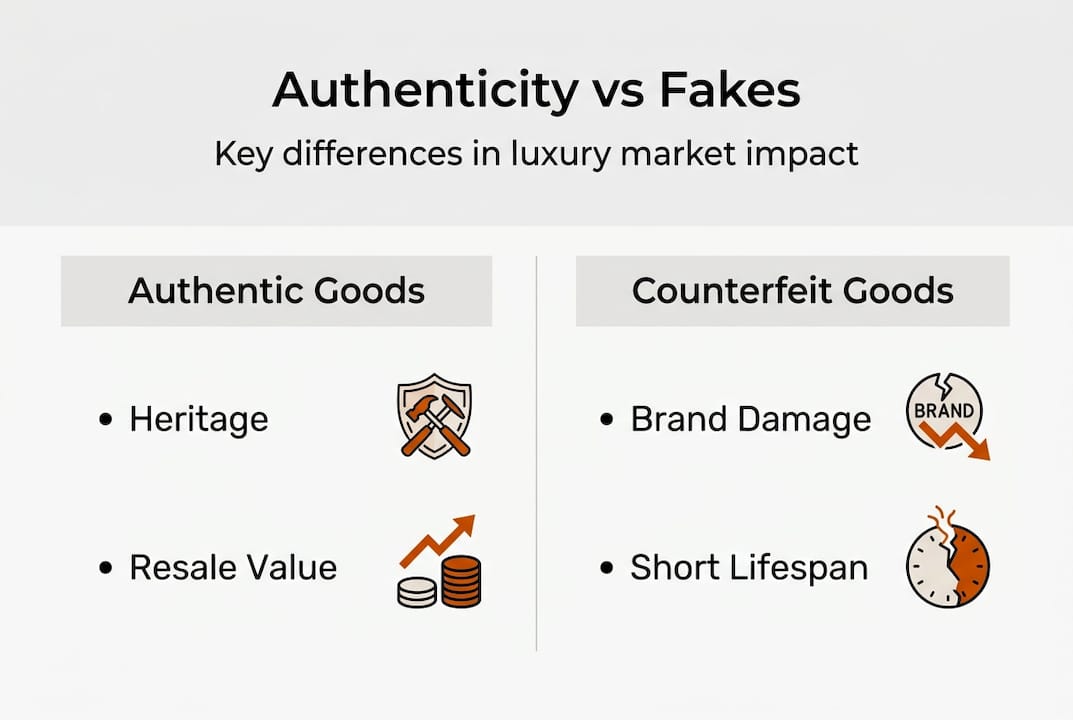
There is also the so-called authenticity paradox. Some high-quality fakes are produced in the same factories as genuine goods, using similar materials and processes. This leads some commentators to argue that authenticity is largely branding, a story told around an object rather than an intrinsic property of it.
It is a provocative argument, but it does not hold up under scrutiny for several reasons:
- Resale markets are unforgiving. Authentication services now use microscopic analysis, UV light, and material testing. A fake, however well made, will be identified and will fetch nothing.
- Legal risk is real. In France, Italy, and increasingly the UK, purchasing known counterfeits carries legal consequences. Ignorance is not always a defence.
- The supply chain matters. Even “high-quality” fakes involve labour practices and material sourcing that cannot be verified or trusted.
- Provenance is part of the value. Knowing a piece was made by a named artisan in a specific region of Italy is not a marketing story. It is a fact that affects the object’s meaning and worth.
- Long-term performance diverges. Even the best fakes begin to show their limitations within a few years. Authentic pieces do not.
“The authenticity paradox is intellectually interesting, but it is also largely irrelevant to anyone who has carried a genuine Italian leather bag for ten years and watched it become more beautiful.”
Pro Tip: If you are ever uncertain about a seller’s credentials, consult resources like leather bag expert insights or seek out best leather bag companies with transparent provenance and verifiable artisan relationships.
For savvy buyers, the practical takeaways are clear. The mixed academic evidence on brand image does not change the personal, financial, and ethical calculus. Buying authentic is not just about protecting a brand. It is about protecting yourself.
Our perspective: What most discussions about authenticity in luxury goods overlook
Most conversations about authenticity in luxury goods frame the issue as either economics or ethics. The financial case is made. The moral argument is rehearsed. And then the discussion ends, as though the only reasons to buy genuine are to protect your investment or avoid contributing to crime.
We think that misses the most important part entirely.
There is something that happens when you carry an object you know was made by a skilled person, working with exceptional materials, in a tradition that stretches back generations. It is not status. It is not the logo. It is a felt connection to human skill and care. That connection changes your relationship with the object. You use it differently. You care for it. You notice it.
The history of Italian leather bags is the history of families, workshops, and regional traditions that survived industrialisation precisely because the work they produced could not be replicated by machines. When you buy authentic, you are participating in that continuity. You are not just acquiring a bag. You are choosing to value something made with genuine intention.
That is a form of self-respect. It says something about how you want to move through the world, what you want to pass on, and what kind of consumption you want to practise. Authenticity, at its deepest level, is not a market transaction. It is a values statement. And for women who have worked hard, developed their taste, and know what they want, it is the only choice that feels entirely right.
Discover authentic Italian creations for your own legacy
If this guide has clarified why authenticity matters so deeply, the natural next step is finding pieces that live up to that standard. At San Rocco Italia, every handbag and leather good in our collection is made in Italy by skilled artisans using premium full-grain leather and time-honoured techniques. We are a woman-owned boutique, and we built our collection around a single principle: that luxury should be genuine, traceable, and made to last.
Our carefully curated pieces are not just beautiful. They are investments in craft, in heritage, and in your own story. The remainder of our collection is sourced from trusted European makers chosen for the same commitment to quality and authenticity. When you are ready to invest in something that will grow more meaningful with every year, explore the San Rocco Italia collection and find the piece that speaks to your own sense of style and legacy.
Frequently asked questions
How can I quickly spot a fake Italian handbag?
Examine the stitching closely, test the weight and texture of the leather, and request authentication documents from the seller. Authentic Italian bags use vegetable-tanned leather from the top 1% of hides, producing a quality and consistency that fakes simply cannot replicate.
Is buying a counterfeit luxury bag illegal?
In many countries, including France, Italy, and increasingly the UK, purchasing counterfeit goods is illegal and can result in fines. Resale markets and legal risks make the consequences of owning a fake far greater than most buyers anticipate.
Do authentic luxury bags keep their value over time?
Genuine Italian pieces typically retain or appreciate in value due to material quality, artisan provenance, and strong resale demand. Authenticity guarantees investment security that counterfeits can never provide.
How do counterfeits affect the reputation of luxury brands?
Counterfeits erode the exclusivity, trust, and legacy that luxury brands spend generations building, resulting in measurable economic losses and diminished prestige. Counterfeiting erodes brand trust in ways that affect the entire market, not just individual houses.



